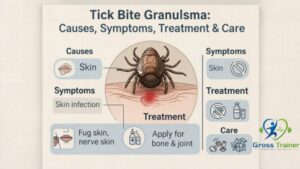
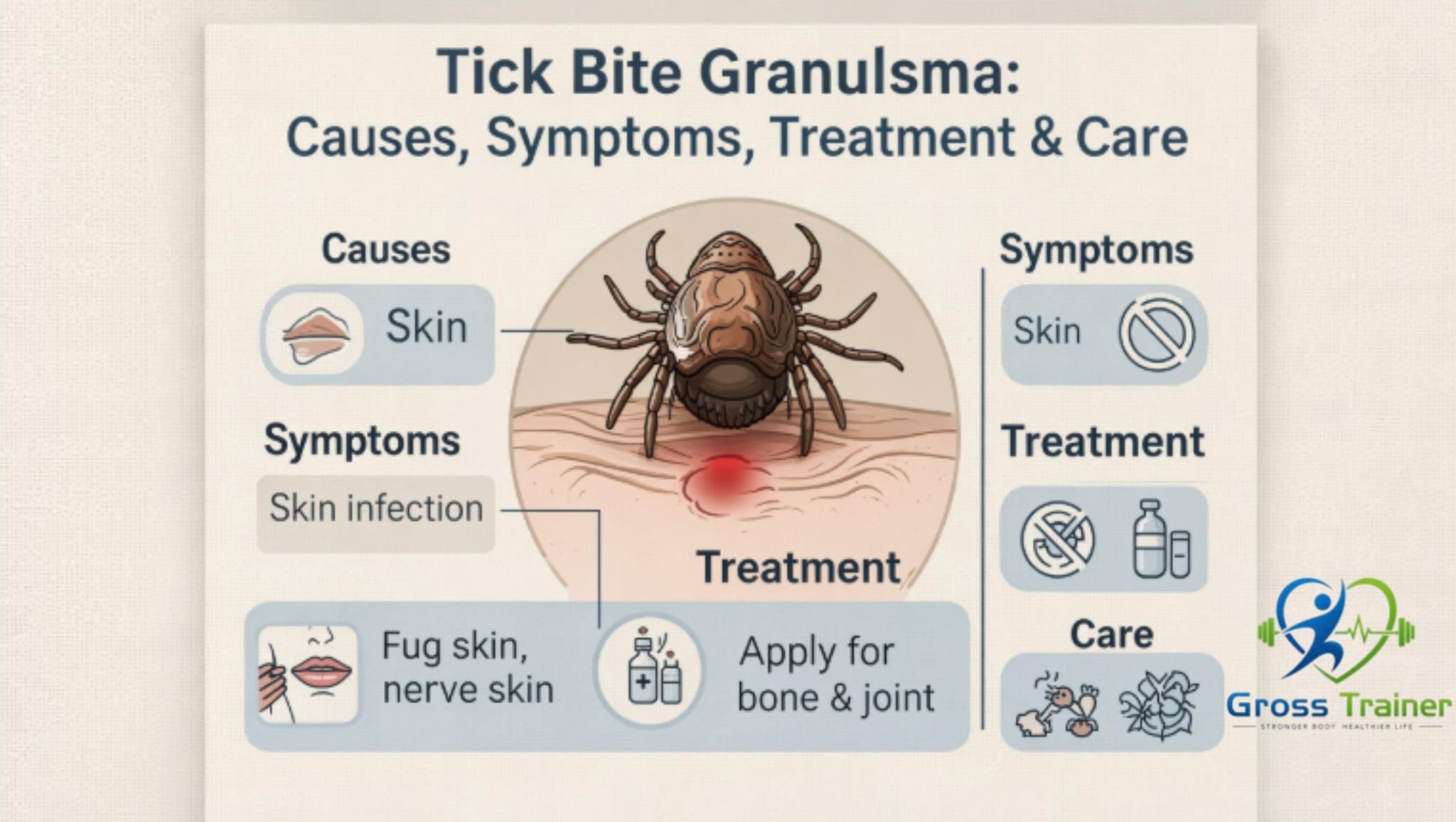
A tick bite can be unsettling enough—but when the spot turns into a firm lump that refuses to go away, it can feel even more worrying. A tick bite granuloma is a small, persistent skin nodule that may form after a tick bite, sometimes lasting weeks, months, or even longer.
The good news is that this kind of lump is often a local skin reaction, not automatically a sign of Lyme disease or a dangerous infection. Still, it deserves attention because tick bites can also be linked with rashes, fever, body aches, and other symptoms that should not be ignored. The CDC notes that tick-borne diseases can cause fever, chills, headache, fatigue, muscle aches, and rashes, depending on the infection.
[Image: A close-up medical-style illustration of a small raised skin nodule after a tick bite, with a calm clinic background.]
What makes this topic confusing is timing. A simple bite reaction may fade in days, but a granuloma can hang around long after the tick is gone. Some people notice itching or tenderness. Others only feel a pea-like bump under the skin.
This guide explains what a tick bite granuloma is, why it happens, how it differs from infection or Lyme rash, what treatment may involve, and when you should call a healthcare professional.
What Is a Tick Bite Granuloma?
A tick bite granuloma is a firm bump or nodule that forms at the site of a tick bite because the immune system keeps reacting in that area. It is usually a localized inflammatory reaction in the skin.
DermNet describes chronic tick bite lesions as papules, nodules, or plaques that can persist over days to months and may form a tick bite granuloma, often around 0.5 to 2 cm in size.
Simple Definition
A granuloma is a small area of organized inflammation. It forms when immune cells gather around something the body sees as irritating, foreign, or difficult to clear.
After a tick bite, this may happen because of:
- Tick saliva left in the skin
- Local immune reaction
- Retained tick mouthparts
- Repeated scratching
- Skin trauma from removal
- Delayed hypersensitivity reaction
- Secondary irritation or inflammation
A granuloma is not the same thing as a simple red bite mark. It tends to feel firmer and last longer.
What It Looks and Feels Like
A typical lesion may appear as:
- A small firm bump
- A pink, red, brown, or skin-colored nodule
- A slightly raised papule
- An itchy spot
- A tender bump
- A lump that feels fixed in the skin
- A spot that remains after the original bite healed
It may look minor, but the persistence is what usually makes people notice it.
Why Does a Tick Bite Granuloma Form?
A tick bite granuloma forms because the skin’s immune system continues to react after the bite. Ticks attach with their mouthparts and feed on blood. During feeding, they release saliva that contains substances that help them stay attached and avoid being noticed by the host’s immune system.
The body may react to that saliva, the bite injury, or tiny retained material in the skin. You may also read about Transaminitis: Causes, Symptoms, Diagnosis and Treatment.
Tick Saliva Can Trigger Inflammation
Tick saliva is not just moisture. It contains biologically active substances. These can trigger itching, redness, swelling, and delayed skin reactions.
Even after the tick is removed, the immune system may keep responding to what happened at the bite site. This can lead to a persistent nodule.
Retained Mouthparts May Play a Role
Sometimes the tick’s body is removed, but small mouthparts remain embedded in the skin. This does not always cause a serious problem, but it may keep the area irritated.
A medical case report notes that reactions to tick bites can persist for months to years and may sometimes produce granulomatous inflammation.
Scratching Can Keep the Lump Active
Itching is common after bites. But repeated scratching can worsen inflammation, break the skin, and increase the chance of secondary infection.
A spot that might have settled down in a week can become stubborn when it is scratched daily.
Tick Bite Granuloma vs Normal Tick Bite Reaction
Not every bump after a tick bite is a granuloma. Most tick bite reactions are mild and short-lived.
A normal bite reaction may cause temporary redness, itching, swelling, or a small bump. A granuloma is more persistent and usually feels firmer.
[Image: Infographic comparing normal tick bite reaction, tick bite granuloma, infection, and expanding Lyme-type rash.]
Normal Bite Reaction
A typical local reaction may include:
- Mild redness
- Itching
- Slight swelling
- Small scab
- Tenderness for a few days
- Gradual fading
This usually improves with basic care.
Granuloma-Type Reaction
A granuloma-like reaction is more likely if the bump:
- Lasts for weeks or months
- Feels firm or rubbery
- Stays in the same place
- Does not spread widely
- May itch repeatedly
- May remain after redness fades
- Looks like a small nodule rather than a flat rash
The key difference is persistence.
Infection
A skin infection is different. It may cause spreading redness, warmth, pain, pus, swelling, fever, or red streaks.
If the spot is getting worse instead of slowly settling, it should be checked.
Tick Bite Granuloma vs Lyme Disease Rash
A tick bite granuloma is a localized lump. A Lyme disease rash is usually an expanding rash that grows outward over time.
This difference matters because Lyme disease needs medical treatment. The CDC states that erythema migrans rash occurs in about 70% to 80% of infected people, begins at the bite site after 3 to 30 days, and expands gradually over several days, sometimes reaching 12 inches or more.
What Lyme Rash May Look Like
A Lyme rash may be:
- Expanding
- Round, oval, or irregular
- Warm but often not painful
- Sometimes bull’s-eye shaped
- Larger than a simple bite reaction
- Associated with fever, fatigue, headache, or body aches
Not every Lyme rash has a perfect bull’s-eye shape. Some are evenly red. Some look bruise-like or unusual.
What a Granuloma Usually Does
A granuloma usually stays more localized. It may be raised, firm, and small. It does not typically expand into a large rash over days.
Still, you can have a local lump and also develop a tick-borne illness separately. That is why symptoms after a tick bite matter.
Symptoms That May Come With Tick Bite Granuloma
The lump itself may be the only symptom. Some people feel completely fine otherwise.
Others may notice itching, soreness, or skin discoloration at the site.
Local Skin Symptoms
Possible local symptoms include:
- Firm bump
- Itching
- Mild tenderness
- Redness
- Brown or purple discoloration
- Scabbing
- Thickened skin
- Burning sensation
- Sensitivity when clothing rubs the area
Some lesions are more annoying than painful.
Symptoms That Suggest Something More Than a Local Lump
Call a healthcare professional if you develop:
- Fever
- Chills
- Headache
- Fatigue
- Muscle aches
- Joint pain
- Swollen lymph nodes
- Expanding rash
- Neck stiffness
- Facial weakness
- Shortness of breath
- Chest discomfort
- Severe pain around the bite
- Pus or spreading redness
CDC guidance notes that tick-borne diseases can cause fever, aches, pains, and different types of rashes, depending on the disease.
How Long Can a Tick Bite Granuloma Last?
A tick bite granuloma can last longer than a normal bite reaction. Some fade over weeks. Others remain for months.
DermNet notes that chronic or late skin manifestations from tick bites may persist over days to months and form nodules or granulomas.
Why It May Take So Long
The immune system can be slow to calm down once a granuloma forms. If retained mouthparts, ongoing scratching, or chronic inflammation are involved, the area may remain active.
Healing may also depend on:
- Tick species
- Depth of the bite
- How long the tick was attached
- Removal technique
- Personal immune response
- Skin sensitivity
- Whether infection developed
- Whether the site is repeatedly irritated
When a Long-Lasting Lump Should Be Checked
A lump that persists for more than a few weeks should be reviewed if it is growing, painful, changing color, bleeding, crusting, draining, or difficult to distinguish from another skin condition.
It is especially worth checking if you are unsure whether the original tick was fully removed.
Diagnosis: How Doctors Identify It
Doctors usually start with the story and skin exam. They may ask when the tick bite happened, how the tick was removed, whether the tick was engorged, and whether symptoms developed afterward.
They may also ask where the bite happened, because tick-borne disease risk depends heavily on geography.
[Image: A clinician examining a small raised bite-site nodule on a patient’s arm with a dermatoscope.]
Medical History Questions
Your doctor may ask:
- When did the bite happen?
- How long was the tick attached?
- Was the tick removed fully?
- Did the lump appear immediately or later?
- Has it grown or changed?
- Is it itchy, painful, or draining?
- Have you had fever or flu-like symptoms?
- Have you noticed an expanding rash?
- Did you travel or hike recently?
- Have you had previous tick bites?
These details help separate a local skin reaction from a possible infection.
Skin Examination
The doctor may examine the lump’s size, color, texture, warmth, tenderness, and borders. They may also check nearby lymph nodes and look for rashes elsewhere on the body.
If the lesion is unusual, persistent, or concerning, a dermatologist may use dermoscopy or consider a biopsy.
Biopsy
A biopsy is not needed for every bump. It may be considered if the diagnosis is unclear, the lesion looks unusual, or it does not improve.
A biopsy can help distinguish granuloma from other skin conditions, cysts, dermatofibroma, infection, or rarely skin cancer.
Treatment Options for Tick Bite Granuloma
Treatment depends on the size, symptoms, and whether infection or retained material is suspected.
A small, painless lump may only need observation. A bothersome or persistent lesion may need medical treatment.
Watchful Waiting
If the bump is small, stable, and not painful, your doctor may recommend monitoring it.
You may be told to:
- Avoid scratching
- Keep the area clean
- Watch for spreading redness
- Track size changes
- Return if it grows or becomes painful
Some granulomas slowly fade with time.
Topical Treatment
If itching or inflammation is present, a clinician may recommend a topical anti-inflammatory medicine, such as a corticosteroid cream, for a limited period.
Do not use strong steroid creams on your own for long periods, especially on the face, groin, or thin skin.
Injection Treatment
For a stubborn inflammatory nodule, a dermatologist may sometimes use an intralesional corticosteroid injection. This means a small amount of medicine is injected directly into the lesion.
This is not needed for every case, but it may help selected persistent inflammatory nodules.
Surgical Removal
If a tick bite granuloma persists, is symptomatic, or contains retained tick parts, surgical removal may be considered. Published case literature has discussed surgical treatment for persistent tick bite granuloma, especially when long-term reaction continues.
Surgery is usually a small local procedure, but the decision depends on the lesion, location, symptoms, and medical judgment.
Antibiotics
Antibiotics are not automatically needed for every granuloma. They may be used if there is bacterial skin infection or if a tick-borne illness is suspected or diagnosed.
A firm lump alone does not prove Lyme disease. A doctor will consider symptoms, rash pattern, tick exposure, location, and testing when appropriate.
Home Care for a Tick Bite Lump
Home care can help reduce irritation, but it cannot replace medical care when warning signs appear.
The goal is to keep the skin calm and avoid making the reaction worse.
What You Can Do
Try these simple steps:
- Wash the area gently with soap and water.
- Avoid scratching or picking.
- Use a cold compress for itching.
- Cover the area if clothing rubs it.
- Keep fingernails short if itching is intense.
- Take photos every few days to track changes.
- Mark the edge of any spreading redness with a pen.
Photos can be surprisingly helpful during a doctor visit.
What Not to Do
Avoid:
- Digging into the skin with tweezers or needles
- Cutting the lump at home
- Applying harsh chemicals
- Burning the area
- Repeatedly squeezing it
- Using leftover antibiotics
- Ignoring fever or an expanding rash
Trying to remove suspected mouthparts at home after the skin has healed can cause more trauma.
Proper Tick Removal to Lower Skin Reaction Risk
Good removal technique may reduce irritation and may lower the chance of leaving mouthparts behind.
The CDC recommends using fine-tipped tweezers to grasp the tick close to the skin and pull upward with steady, even pressure, then cleaning the bite area and hands afterward.
Step-by-Step Removal
If a tick is still attached:
- Use fine-tipped tweezers.
- Grab the tick as close to the skin as possible.
- Pull upward slowly and steadily.
- Do not twist or jerk.
- Clean the bite area with soap and water or alcohol.
- Wash your hands.
- Save a photo of the tick if possible.
- Monitor the bite site and your symptoms.
Do not use petroleum jelly, nail polish, heat, or matches. These methods can delay proper removal.
What If Mouthparts Stay Behind?
If tiny mouthparts remain, the skin may push them out over time. Do not aggressively dig. If the area becomes painful, infected, or forms a persistent lump, get medical advice.
When to See a Doctor
A tick bite should be taken seriously when symptoms go beyond a small local bump.
You should call a doctor if the lump is not improving, if it grows, or if you develop symptoms that may suggest infection or tick-borne illness.
See a Doctor for the Lump If
- It lasts more than a few weeks
- It is growing
- It becomes painful
- It drains pus
- It bleeds
- It changes color or shape
- It is warm and swollen
- You suspect retained tick parts
- It is on the face, genitals, or near the eye
- You are immunocompromised
Seek Medical Care Quickly If
- You develop fever or chills
- You have an expanding rash
- You feel unusually fatigued
- You develop severe headache
- You have muscle or joint aches
- You have facial drooping
- You feel confused
- You have chest pain or shortness of breath
- You have neck stiffness
Johns Hopkins Lyme Disease Research Center advises seeking medical care for a suspicious expanding circular rash or flu-like symptoms after a tick bite, such as fever, aches, extreme fatigue, severe headache, or neck pain.
Can a Tick Bite Granuloma Be Prevented?
You cannot prevent every skin reaction, but you can reduce your risk by preventing tick bites and removing ticks correctly.
Prevention matters because ticks can transmit infections as well as cause local skin reactions.
Avoid Tick Bites Outdoors
Use practical steps:
- Wear long sleeves and long pants in tick-heavy areas.
- Tuck pants into socks when hiking in grass or brush.
- Use EPA-registered insect repellent.
- Stay near the center of trails.
- Avoid brushing against tall grass.
- Treat clothing with permethrin when appropriate.
- Shower after outdoor exposure.
- Check your body carefully after being outside.
Ticks often hide in warm, protected areas.
Check Common Tick Hiding Places
After outdoor activity, check:
- Scalp
- Behind ears
- Neck
- Armpits
- Waistline
- Belly button
- Groin
- Behind knees
- Ankles
- Between toes
A quick tick check can prevent a tick from staying attached longer than necessary.
Myths About Tick Bite Granuloma
Tick bites create a lot of anxiety, and the internet can make that worse. Let’s clear up a few common myths.
Myth: Every Tick Bite Lump Means Lyme Disease
Not true. A lump at the bite site may be a local inflammatory reaction. Lyme disease is more strongly suggested by an expanding rash, flu-like symptoms, and risk factors based on tick type and location.
Still, symptoms after a bite should be taken seriously.
Myth: If the Tick Head Stayed In, You Will Definitely Get Sick
Retained mouthparts may irritate the skin, but they do not automatically mean you will get a tick-borne illness. Disease transmission is more related to the infected tick’s feeding process than a tiny leftover fragment after removal.
However, retained material can contribute to local inflammation.
Myth: A Bull’s-Eye Rash Always Appears With Lyme Disease
Not always. Some people with Lyme disease do not notice a rash, and not every rash looks like a perfect bull’s-eye. CDC data says erythema migrans occurs in approximately 70% to 80% of infected people.
Myth: You Should Burn or Smother a Tick
No. Burning, smothering, or coating the tick can delay removal and may increase irritation. Fine-tipped tweezers are the recommended method.
FAQ
What is a tick bite granuloma?
A tick bite granuloma is a persistent firm bump that forms at the site of a tick bite because the immune system keeps reacting in the skin. It may appear as a small nodule that lasts for weeks or months.
Is a tick bite granuloma dangerous?
Usually, it is a local inflammatory skin reaction and not dangerous by itself. However, tick bites can also be linked with infections, so symptoms like fever, expanding rash, severe headache, or joint pain should be checked.
How long does a tick bite granuloma last?
It can last weeks to months. Some cases persist longer, especially if there is ongoing inflammation, retained mouthparts, or repeated scratching.
Does a tick bite granuloma mean the tick head is still inside?
Not always. Retained mouthparts can contribute to irritation, but a granuloma can also form from immune reaction to tick saliva or bite trauma.
Should I squeeze the lump?
No. Squeezing can irritate the skin, worsen inflammation, or introduce infection. If the lump is painful, growing, or persistent, let a healthcare professional examine it.
Can it be treated at home?
Mild symptoms may improve with gentle skin care, cold compresses, and avoiding scratching. Persistent, painful, growing, draining, or unusual lumps should be evaluated by a doctor.
Do antibiotics remove a tick bite granuloma?
Antibiotics do not usually remove a simple granuloma unless there is infection or a diagnosed tick-borne illness. Treatment depends on the cause and symptoms.
When should I worry after a tick bite?
Call a doctor if you develop fever, chills, headache, fatigue, muscle aches, joint pain, swollen lymph nodes, or an expanding rash. Also seek care if the bite site becomes very painful, warm, swollen, or drains pus.
Can a tick bite granuloma be surgically removed?
Yes, in some persistent or symptomatic cases, a dermatologist or surgeon may remove it. This is usually considered when the lesion does not improve, is bothersome, or contains suspected retained tick material.
Conclusion
A tick bite granuloma can be frustrating because it often lasts much longer than a normal bite mark. It may feel firm, itchy, tender, or simply odd under the skin. In many cases, it is a local immune reaction rather than an emergency.
Still, it should not be ignored if it grows, becomes painful, drains, changes appearance, or comes with fever, fatigue, body aches, swollen lymph nodes, or an expanding rash. Tick bites can cause both local skin reactions and tick-borne illnesses, so the full picture matters.
The safest approach is calm observation, proper skin care, and timely medical review when symptoms do not fit a simple healing bite. A small lump may be harmless, but the right checkup can give peace of mind and prevent missed problems.