A small number on a blood test can create a surprisingly big wave of worry. If your report says anion gap low, you may be wondering whether it points to something serious, something temporary, or just a lab mistake.
The good news is that a low anion gap is uncommon, and many cases are not dangerous by themselves. Still, it should not be ignored. The anion gap is a calculated value from common blood tests, usually a basic metabolic panel or comprehensive metabolic panel, and it helps doctors understand electrolyte and acid-base balance in the body.
Think of it as one clue in a larger medical puzzle. A low result may be linked to low albumin, lab measurement issues, certain medications, unusual electrolyte changes, or blood protein disorders. In many situations, the next step is simply repeating the test and reviewing the full panel with a healthcare professional.
This guide explains what an anion gap low result can mean, why it happens, what symptoms may matter, and what your doctor may check next.
What Is the Anion Gap?
The anion gap is a calculated number that compares certain positively charged and negatively charged particles in your blood. These particles are called electrolytes, and they include sodium, chloride, and bicarbonate.
Doctors often use the anion gap to help evaluate whether the blood has too much acid, too little acid, or an electrolyte imbalance. It is not usually a separate blood draw. It is commonly calculated from results already included in a BMP, CMP, electrolyte panel, or renal function panel.
The Basic Definition
A common formula is:
Anion gap = sodium − chloride − bicarbonate
Some laboratories include potassium in the formula, but many do not. Because different labs use different equipment, formulas, and reference ranges, your result should always be interpreted using the range printed on your own report.
The “gap” does not mean there is literally an empty space in your blood. It reflects unmeasured charged particles, including proteins and other substances that are not listed directly in the formula.
Why Doctors Care About It
The anion gap helps doctors understand what may be happening with the body’s chemistry. A high anion gap often gets more attention because it can be linked with metabolic acidosis, such as diabetic ketoacidosis, kidney failure, lactic acidosis, or toxin exposure.
A low anion gap is less common, but it can still be useful. It may point toward low albumin, measurement error, medication effects, or increased positively charged proteins in the blood. A Cleveland Clinic Journal of Medicine review notes that overlooking a low result can sometimes miss acute or chronic conditions that need treatment.
What Does anion gap low Mean?
An anion gap low result means the calculated gap between measured positive and negative electrolytes is below the lab’s normal reference range. Some modern discussions define a low anion gap as less than or equal to about 3 mEq/L, but ranges vary by laboratory and testing method.
It is important to understand that the result is not a diagnosis. It is a clue. Your doctor will usually look at sodium, chloride, bicarbonate, albumin, kidney function, liver markers, medications, symptoms, and previous blood work before deciding what it means. You may also read this: Foods to Avoid While Taking Sucralfate: Safe Eating Tips.
Is a Low Result Always Dangerous?
No. A low result is not automatically dangerous. In fact, testing error is described as the most common reason for a low serum anion gap, and repeating the electrolyte panel is often the first step.
That said, a repeated low result deserves attention. If it appears again, your doctor may check albumin, total protein, kidney function, liver function, calcium, magnesium, and medication history.
Why One Abnormal Number Is Not Enough
Blood chemistry results are connected. Sodium, chloride, bicarbonate, albumin, and kidney function all influence interpretation. A low number on its own can look scary, but it may make perfect sense once the rest of the panel is reviewed.
For example, someone with low albumin may have a low anion gap even if sodium, chloride, and bicarbonate are not dramatically abnormal. Someone else may have a falsely low result because of a lab or measurement issue.
Common Causes of a Low Anion Gap
There are several possible reasons for an anion gap low result. Some are simple. Others need more careful follow-up.
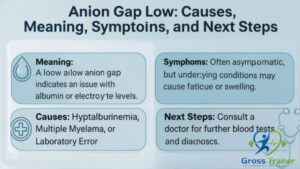
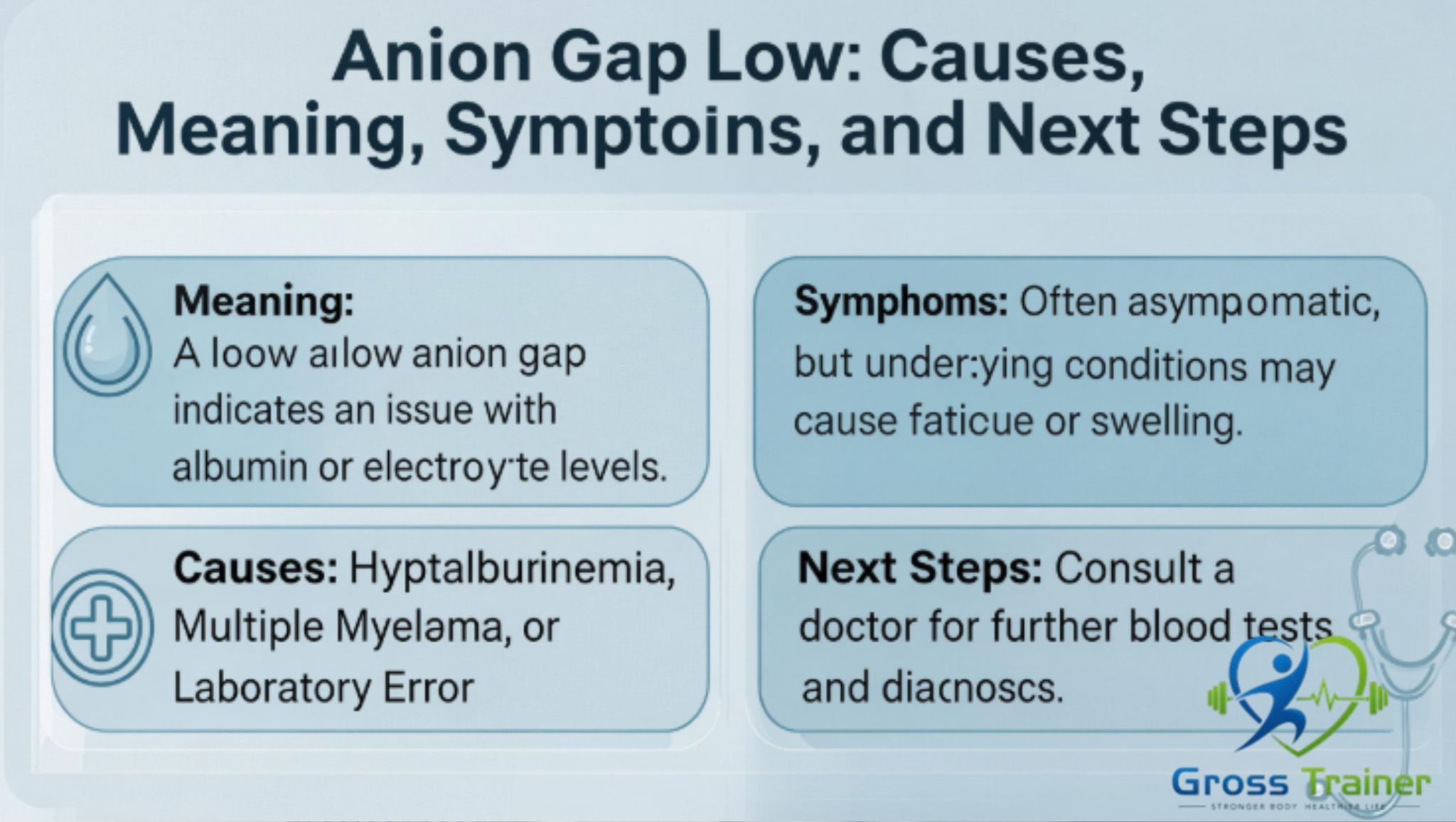
The most common possibilities include lab error, low albumin, increased positively charged proteins, lithium therapy or toxicity, and certain measurement interferences.
1. Laboratory or Testing Error
This is often the first thing doctors consider. The anion gap is calculated from other test values, so any error in sodium, chloride, or bicarbonate can shift the final number.
A sample issue, machine variation, or measurement interference can make the gap look lower than it really is. This is why repeat testing is commonly recommended before assuming there is a true medical problem.
2. Low Albumin
Albumin is a major protein in the blood, and it carries a negative charge. Because albumin contributes to the unmeasured anions in the blood, low albumin can lower the anion gap.
This is one of the most clinically important causes. StatPearls explains that albumin changes can affect the anion gap, and reduced albumin may hide an acid-base problem if the gap is not interpreted carefully.
Low albumin may be related to:
- Liver disease
- Kidney disease with protein loss
- Malnutrition
- Chronic inflammation
- Severe infection
- Burns or major illness
- Certain gastrointestinal conditions
If your albumin is low, your doctor will usually focus on why it is low rather than treating the anion gap number itself.
3. Increased Blood Proteins
Sometimes, the anion gap falls because the blood contains more positively charged proteins than usual. This can happen with certain plasma cell or immune protein conditions.
One commonly discussed example is monoclonal gammopathy, including multiple myeloma. Not everyone with a low anion gap has this condition, and most people should not jump to that conclusion. But if the low result is persistent and unexplained, doctors may order tests such as total protein, serum protein electrophoresis, or immunofixation.
4. Lithium Use or Lithium Toxicity
Lithium is a medication used for some mood disorders. Because lithium is a positively charged ion, high levels can reduce the anion gap.
If a person takes lithium and has an anion gap low result, the doctor may check a lithium level, kidney function, and symptoms of toxicity. Symptoms of lithium toxicity can include tremor, confusion, vomiting, diarrhea, poor coordination, and drowsiness.
This is not something to manage alone. Anyone taking lithium should follow their prescriber’s monitoring plan carefully.
5. High Chloride or Chloride Measurement Interference
Chloride is part of the formula. If chloride is truly high, or if the lab falsely reads another substance as chloride, the anion gap can appear low.
Certain substances, including bromide or iodide exposure, can interfere with chloride measurement in some methods. A Cleveland Clinic Journal of Medicine review describes chloride overestimation as one mechanism behind low anion gap results.
6. High Calcium or Magnesium
Very high levels of positively charged minerals such as calcium or magnesium can reduce the gap, though this is less common as a sole explanation.
If these minerals are abnormal, your doctor will interpret them in context. High calcium, for example, may require evaluation of parathyroid function, kidney function, medications, supplements, or other conditions.
7. Severe Illness or Complex Medical Conditions
In hospitalized or critically ill patients, the anion gap can be affected by many overlapping factors. Albumin may be low, kidney function may change, medications may interfere, and fluid shifts can alter electrolytes.
This is why interpretation is different for a healthy outpatient compared with someone in the ICU, emergency room, or hospital.
Symptoms: Can an Anion Gap Low Result Make You Feel Sick?
The anion gap itself usually does not cause symptoms. It is a calculated number, not a disease. Symptoms come from the underlying reason behind the abnormal result.
Many people discover a low value during routine blood work and feel completely normal. Others may have symptoms related to low albumin, kidney disease, liver disease, medication side effects, or an electrolyte imbalance.
Symptoms That May Matter
Contact a healthcare professional if a low result appears with symptoms such as:
- New confusion
- Severe weakness
- Fainting or near-fainting
- Swelling in the legs or abdomen
- Shortness of breath
- Persistent vomiting or diarrhea
- Yellowing of the skin or eyes
- Unexplained weight loss
- Bone pain
- Severe dehydration
- Irregular heartbeat
- New tremors, especially if taking lithium
These symptoms do not prove that the anion gap is the cause. They simply mean the full clinical picture needs medical review.
When It May Be an Incidental Finding
If you feel well and the rest of your blood work is normal, an anion gap low result may turn out to be a one-time lab variation.
Your doctor may repeat the metabolic panel and compare it with older results. If the repeat test is normal, no further workup may be needed.
How Doctors Evaluate a Low Anion Gap
Doctors usually take a step-by-step approach. The goal is not to chase one number blindly, but to confirm whether the result is real and find the reason if it persists.
The evaluation often starts with a repeat electrolyte panel, then moves toward albumin and protein testing if needed.
Step 1: Repeat the Test
Because testing error is common, repeating the blood test is often the most practical first step. If the new result is normal, the original value may have been a measurement issue.
If the gap remains low, your doctor will look more closely at the rest of the chemistry panel.
Step 2: Check Albumin
Albumin is one of the most important values to review. A low albumin level can pull the anion gap down.
Doctors may also look at liver enzymes, kidney tests, urine protein, nutrition status, inflammation markers, and symptoms such as swelling or unexplained weight loss.
Step 3: Review Medications and Supplements
Medication history matters. Lithium is one medication that can lower the anion gap when levels are high. Some exposures or supplements may also interfere with lab measurements.
Tell your doctor about:
- Prescription medicines
- Over-the-counter medicines
- Herbal products
- Supplements
- Recent contrast studies
- Unusual chemical exposures
- Any change in dose or medication timing
This information can prevent unnecessary worry and help the doctor interpret the result correctly.
Step 4: Look at Total Protein and Globulin
If albumin is normal and the low result persists, doctors may check blood protein levels. High globulin or abnormal proteins may lead to further testing.
These tests can help look for monoclonal proteins, chronic inflammation, immune conditions, or other causes of altered blood protein balance.
Step 5: Consider Kidney, Liver, and Acid-Base Status
Kidneys and liver function are often part of the larger review. The kidneys help regulate acid-base balance and electrolytes, while the liver plays a major role in albumin production.
A doctor may also interpret bicarbonate, carbon dioxide, chloride, creatinine, blood urea nitrogen, calcium, magnesium, and sometimes blood gas results if the clinical situation is more serious.
Anion Gap Low and Albumin: Why the Connection Matters
Low albumin is one of the most important reasons an anion gap can fall. Albumin is negatively charged, so when there is less albumin in the blood, the calculated gap becomes smaller.
This matters because low albumin can sometimes make a dangerous high anion gap acidosis look less obvious. In other words, the anion gap may appear normal or low even when acid-base problems exist.
What Causes Low Albumin?
Albumin can drop for several reasons. Some involve reduced production, while others involve protein loss or inflammation.
Common causes include:
- Liver disease, because the liver makes albumin
- Kidney disease, especially when protein leaks into urine
- Poor protein intake or malnutrition
- Chronic inflammatory disease
- Serious infection or sepsis
- Digestive disorders that reduce absorption
- Burns or major trauma
If your anion gap low result appears with low albumin, your doctor will usually focus on finding and treating the reason for the albumin problem.
Can Albumin Be Corrected in the Calculation?
Clinicians may use albumin-corrected anion gap calculations in certain patients, especially those who are very ill or have clearly low albumin. This helps prevent underestimating acid-base problems.
You do not need to calculate this yourself. The useful step is asking your healthcare provider whether albumin affects your result.
Anion Gap Low but Feeling Fine: Should You Worry?
A person can have a low anion gap and feel completely normal. That can happen when the value is due to lab variation, mild albumin change, or a result that is only slightly outside the reference range.
If the rest of your panel is normal, and your doctor is not concerned, a repeat test may be enough.
Look at the Pattern, Not One Number
A single abnormal result is less meaningful than a pattern. Doctors often compare:
- Current result
- Previous anion gap values
- Albumin level
- Sodium, chloride, and bicarbonate
- Kidney function
- Liver function
- Total protein and globulin
- Symptoms and medical history
If the number has been low several times, it deserves more attention than one isolated result.
Mildly Low vs Very Low
A slightly low result may not carry the same meaning as a very low or negative result. Very low values are more likely to prompt repeat testing and review for lab error, albumin problems, paraproteins, or medication effects.
Always interpret the value using your lab’s reference range. Normal ranges can differ.
What You Should Ask Your Doctor
If your report shows anion gap low, you do not need to panic—but you should ask clear questions. Good questions help you understand whether the result is important for you personally.
Try asking:
- Is my result only slightly low or very low?
- Should we repeat the electrolyte panel?
- What are my albumin and total protein levels?
- Are my sodium, chloride, and bicarbonate normal?
- Could any of my medicines affect this result?
- Do I need kidney, liver, urine, or protein testing?
- How does this compare with my previous blood work?
- Is this urgent, or can it be followed routinely?
These questions keep the conversation practical and focused.
What Not to Do
Do not try to treat the number with diet, supplements, or electrolyte drinks without medical advice. The right response depends entirely on the cause.
For example, a low result from lab variation needs no treatment. A low result from low albumin needs evaluation of albumin. A low result linked to lithium needs medication-level monitoring. These are different situations.
Treatment: How Is a Low Anion Gap Managed?
There is no universal treatment for a low anion gap. Treatment depends on the underlying cause.
If the result is false or temporary, no treatment may be needed. If it reflects another condition, the treatment is directed at that condition.
If It Is a Lab Error
A repeat test may solve the issue. If the new result is normal, your doctor may simply document it and move on.
If It Is Low Albumin
Treatment depends on why albumin is low. This may involve managing liver disease, kidney protein loss, inflammation, infection, nutrition problems, or digestive disease.
The goal is not just to raise a lab number. The goal is to identify what is causing the low albumin.
If It Is Related to Medication
If lithium or another medication is involved, your doctor may check blood levels, kidney function, dose timing, and symptoms.
Never stop lithium or other prescribed medications suddenly without medical guidance. Stopping abruptly can be risky.
If It Is Related to Blood Proteins
If abnormal proteins are suspected, your doctor may order specialized blood or urine tests. These tests help determine whether the finding is harmless, inflammatory, immune-related, or linked to a plasma cell disorder.
Again, a low result alone does not diagnose these conditions. It simply helps decide whether more testing is reasonable.
When to Seek Prompt Medical Attention
Most low anion gap results are not emergencies. However, urgent care may be needed if the result appears with serious symptoms.
Seek prompt medical help if you have confusion, severe weakness, fainting, chest pain, trouble breathing, severe dehydration, repeated vomiting, irregular heartbeat, or symptoms of lithium toxicity if you take lithium.
Special Situations
Be more cautious if you have:
- Kidney disease
- Liver disease
- Heart failure
- Cancer history
- Severe infection
- Recent hospitalization
- Known low albumin
- Lithium therapy
- Unexplained swelling or weight loss
In these situations, a persistent anion gap low result may deserve closer follow-up.
FAQ
What does anion gap low mean on a blood test?
It means the calculated anion gap is below the lab’s reference range. It may be due to lab error, low albumin, medication effects, high blood proteins, or certain electrolyte changes.
Is an anion gap low result serious?
Sometimes it is harmless, especially if it happens once and the repeat test is normal. If it is persistent or appears with symptoms, it should be reviewed by a healthcare professional.
What is the most common cause of a low anion gap?
Testing error is commonly described as the most frequent reason, so repeat electrolyte testing is often the first step. Low albumin is also a major medical cause.
Can dehydration cause a low anion gap?
Dehydration more often affects electrolytes and kidney-related numbers in different ways. It is not usually the classic cause of a low anion gap, but the overall chemistry panel should be interpreted by a clinician.
Can low albumin lower the anion gap?
Yes. Albumin is a negatively charged blood protein, and lower albumin can reduce the calculated anion gap. This is one of the key reasons doctors check albumin when the gap is low.
Should I repeat the test?
In many cases, yes. Because measurement error is common, doctors often repeat the electrolyte panel before ordering more specialized testing.
Can medications cause an anion gap low result?
Yes. Lithium is one important example, especially if the blood level is high. Some substances can also interfere with chloride measurement and make the gap appear falsely low.
Does a low anion gap mean cancer?
Not usually. A persistent low result can sometimes lead doctors to check blood proteins, but it does not mean cancer by itself. Many other explanations are more common.
Can diet fix a low anion gap?
Not directly. Diet may matter if malnutrition or low protein intake is causing low albumin, but treatment depends on the actual cause. Do not self-treat based on this number alone.
Conclusion
An anion gap low result can look unsettling on a lab report, but it is best understood as a clue rather than a diagnosis. Many cases are caused by testing variation, and repeating the blood test is often the first step.
If the result stays low, the most useful areas to review are albumin, total protein, kidney function, liver function, chloride, bicarbonate, medications, and symptoms. Low albumin is especially important because it can reduce the gap and sometimes hide other acid-base changes.
The safest approach is simple: do not panic, do not self-treat, and do not ignore it. Bring the result to your healthcare provider, ask what pattern they see, and follow the next step based on your full medical picture.