
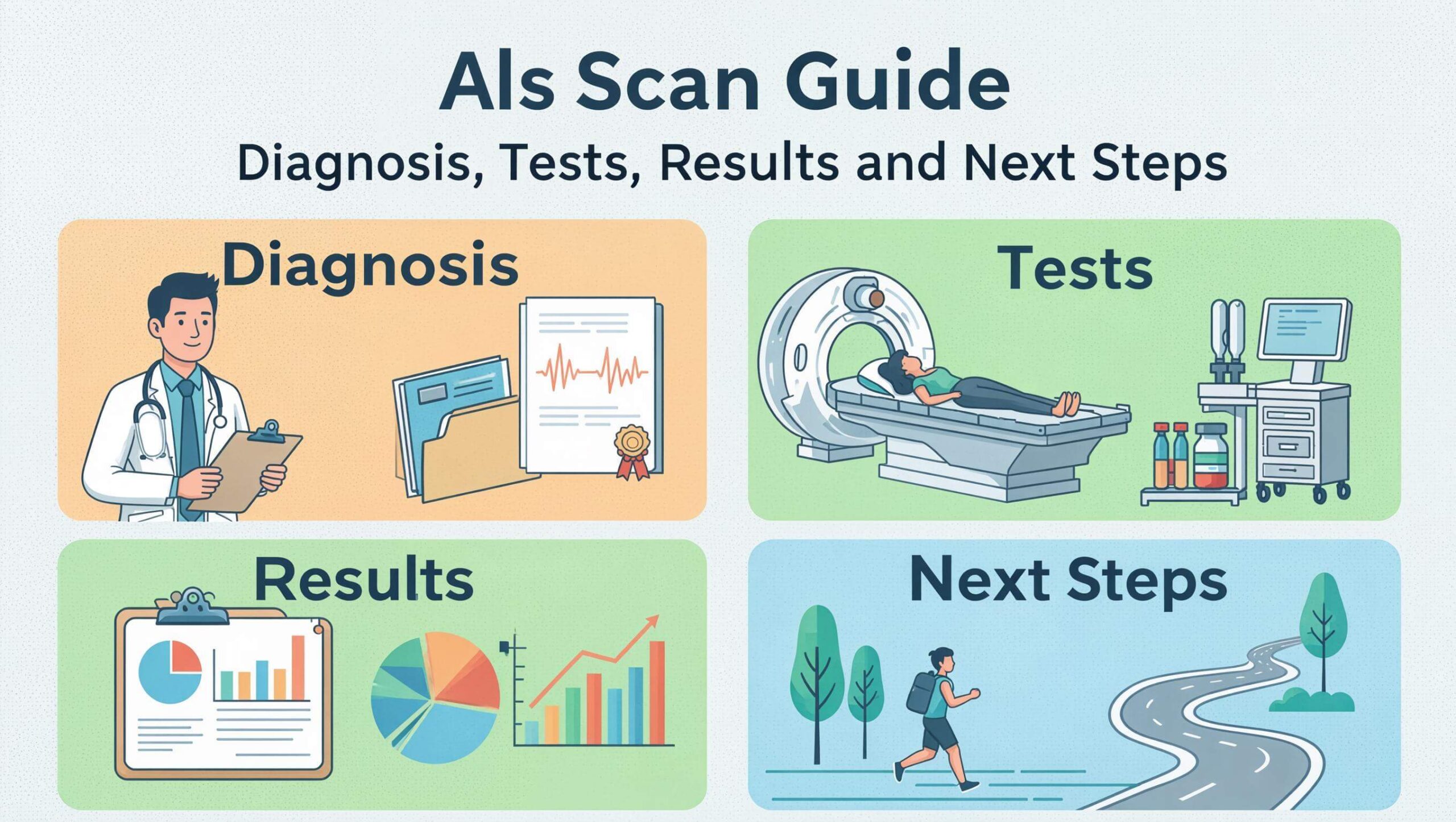
When strange muscle twitching, weakness, or speech changes show up, it is natural for your mind to race. Searching for an als scan often comes from one urgent question: “Can a test finally tell me what is going on?”
That question matters because ALS is serious, but it is also difficult to diagnose early. Many conditions can look similar at first, and a careful evaluation can help doctors rule out treatable problems before reaching a conclusion. Mayo Clinic notes that ALS is diagnosed from symptoms, a physical exam, and tests used to rule out other conditions, especially because early symptoms can overlap with other diseases.
![Image: A neurologist reviewing brain and spine imaging with a patient in a calm clinic setting.]
The reassuring part is that an evaluation is not usually one mysterious scan. It is a step-by-step process that may include a neurological exam, EMG and nerve conduction studies, MRI, lab tests, and sometimes additional procedures depending on the person’s symptoms.
This guide explains what doctors usually mean when people talk about scanning or testing for ALS, what the results can and cannot prove, how to prepare, and which questions are worth asking at your appointment.
What an als scan Can and Cannot Tell You
There is no single picture, blood test, or machine reading that can confirm ALS on its own. UC San Diego Health explains that there is no one essential diagnostic test for ALS and that the diagnosis is ultimately clinical, made by a skilled neurologist rather than by one test alone.
In everyday language, people may use the phrase scan to mean any test that looks for ALS. In a clinic, however, “scan” usually refers to imaging such as MRI, while the wider evaluation may also include electrical studies, blood work, urine tests, spinal fluid testing, or genetic testing. The real purpose is to build a pattern: signs on examination, changes on nerve and muscle testing, symptom history, and the absence of a better explanation.
An MRI may be ordered because ALS-like symptoms can come from other conditions, including spinal cord compression, a herniated disc in the neck, tumors, multiple sclerosis, or other neurological disorders. Mayo Clinic states that MRI is mainly used to rule out other causes, though it may show changes that suggest ALS in some cases.
That distinction is important. A normal MRI does not automatically mean everything is fine, and an abnormal MRI does not automatically mean ALS. The neurologist has to interpret imaging alongside the exam, symptom progression, reflexes, muscle wasting, speech and swallowing changes, and electrodiagnostic findings.
Why ALS Diagnosis Often Takes Time
ALS can begin quietly. One person may notice foot drop, another may struggle with buttons, another may develop slurred speech, and someone else may feel cramps or twitching long before weakness becomes obvious. Because these signs can point in several directions, doctors often take a careful path rather than rushing to a label.
The evaluation may also take time because ALS is partly a diagnosis of pattern and exclusion. In other words, doctors look for upper motor neuron signs, lower motor neuron signs, progression over time, and evidence that another disease is not the better explanation. UC San Diego Health notes that people often have already had MRI scans, EMG and nerve conduction studies, lumbar puncture, blood tests, and genetic testing before diagnosis is established.
![Infographic: The ALS evaluation pathway from symptoms to neurological exam, EMG/NCS, MRI, lab tests, follow-up, and specialist review.]
This waiting period can feel emotionally brutal. Patients may feel caught between fear and uncertainty, while families search for answers late at night. Still, taking the time to check for mimics matters because some ALS-like conditions are treatable or managed very differently.
If symptoms are changing quickly, affecting breathing, or causing sudden severe weakness, it is important to seek urgent medical advice rather than waiting for a routine appointment. ALS usually progresses over time, but sudden neurological symptoms can have other causes that need fast attention.
What a Neurology Testing Appointment May Include
A first specialist visit usually begins with your story. The neurologist will want to know when symptoms began, which body part was affected first, whether weakness is spreading, whether speech or swallowing has changed, and whether there is pain, numbness, or sensory loss.
Then comes the neurological exam. This may include checking strength, reflexes, muscle tone, coordination, walking, eye movements, tongue movement, speech, and signs of muscle wasting or twitching. For readers using als scan as shorthand, this hands-on examination is often just as important as the machines and reports that come later.
Neurological Examination
The neurological examination is the anchor of the entire workup. It can reveal upper motor neuron signs such as stiffness, brisk reflexes, or spasticity, and lower motor neuron signs such as muscle wasting, weakness, fasciculations, and reduced reflexes. Mayo Clinic describes upper and lower motor nerve symptoms as key parts of ALS assessment.
A good exam also looks for clues that point away from ALS. Numbness, prominent sensory loss, severe pain, bladder symptoms, or vision changes may push the doctor to consider other conditions. This is why a detailed physical examination is not just a formality; it guides the next steps.
EMG and Nerve Conduction Studies
For many people, EMG and nerve conduction studies are the most important tests in the ALS workup. MedlinePlus explains that these studies check how well muscles and the nerves that control them are working, and they are often done together.
During an EMG, a very thin needle electrode is placed into selected muscles to record electrical activity at rest and during contraction. During a nerve conduction study, small electrical pulses are used to measure how quickly and strongly nerves send signals. MedlinePlus notes that EMG can show abnormal muscle activity and nerve conduction testing can show slower or weaker signals in damaged nerves.
These tests do not “see” ALS the way a camera sees a broken bone. Instead, they look for patterns of nerve and muscle involvement. In suspected ALS, EMG may show evidence that muscles have lost nerve supply and attempted to reinnervate, while nerve conduction studies help rule out other nerve conditions.
MRI of the Brain and Spine
When people ask for an als scan, they are often picturing an MRI. MRI uses a magnetic field and radio waves to create detailed images of the brain and spinal cord. In ALS evaluation, its main job is to look for other explanations, such as a neck disc pressing on the spinal cord, a tumor, stroke-related changes, inflammation, or other structural problems. Mayo Clinic specifically lists MRI among tests that may help rule out conditions causing similar symptoms.
An MRI is noninvasive, but it can be noisy and may take time. Some people receive contrast dye depending on the clinical question. If you have a pacemaker, metal implants, aneurysm clips, or severe claustrophobia, tell the imaging team before the scan.
You may also read: Posterior Auricular Lymph Nodes: Swelling, Causes, Care.
Blood, Urine, and Other Lab Tests
Blood and urine tests are not glamorous, but they can be very useful. They may check for thyroid disease, vitamin deficiencies, infections, autoimmune conditions, inflammation, metabolic problems, or other causes of weakness and nerve symptoms. Mayo Clinic notes that blood and urine tests may help eliminate other possible causes and that certain blood tests, such as neurofilament light chain testing, may help support early diagnosis.
A lab result rarely answers the whole question by itself. Instead, it adds another piece to the puzzle. A low vitamin level, abnormal thyroid result, or inflammatory marker may change the direction of the workup and sometimes leads to treatment for a different condition.
Lumbar Puncture, Genetic Testing, or Biopsy
Some patients may need a lumbar puncture, also called a spinal tap. This test removes a small amount of spinal fluid for analysis. Mayo Clinic notes that a spinal tap does not diagnose ALS but may reveal another cause of symptoms.
Genetic testing may be considered when there is a family history of ALS, early onset, or features that suggest an inherited form. Muscle or nerve biopsy is less common, but it may be used if the doctor suspects a muscle disease or nerve disease instead of ALS. Mayo Clinic lists muscle and nerve biopsy as possible tests when another type of disease is suspected.
Symptoms That May Lead Doctors to Order Testing
People do not usually get tested for ALS because of one twitch or one bad day at the gym. Doctors become more concerned when symptoms are persistent, progressive, and point toward motor nerve involvement.
Common reasons for referral include:
- Weakness in one hand, arm, foot, or leg
- Tripping, foot drop, or difficulty climbing stairs
- Dropping objects or trouble with buttons and handwriting
- Muscle wasting or visible thinning
- Persistent twitching together with weakness
- Slurred speech, voice changes, or trouble swallowing
- Cramps, stiffness, or spasticity
- Breathing difficulty that cannot be explained by lung or heart disease
Twitching alone is not the same as ALS. Many healthy people experience fasciculations from stress, caffeine, exercise, poor sleep, or benign fasciculation syndrome. The more concerning sign is twitching that appears with progressive weakness, muscle wasting, or abnormal neurological findings.
Pain and numbness also deserve context. ALS can cause discomfort, cramps, and secondary pain, but prominent numbness or sensory loss often makes doctors look for other causes such as neuropathy, spine disease, or entrapment nerve problems.
Conditions Doctors May Try to Rule Out
One of the most valuable parts of testing is that it can uncover conditions that imitate ALS. This is not a small detail; it is central to why the workup is thorough.
Possible mimics include:
- Cervical myelopathy from spinal cord compression
- Multifocal motor neuropathy
- Myasthenia gravis
- Peripheral neuropathy
- Thyroid disease
- Vitamin B12 deficiency
- Muscular dystrophy or other muscle diseases
- Multiple sclerosis
- Stroke or brain lesions
- Infections or inflammatory disorders
- Medication-related muscle problems
MedlinePlus lists several conditions that abnormal EMG or nerve conduction results may point to, including carpal tunnel syndrome, herniated disk, Guillain-Barré syndrome, myasthenia gravis, muscular dystrophy, Charcot-Marie-Tooth disease, and ALS. It also emphasizes that results are interpreted with symptoms, medical history, and other tests.
This is why it can be risky to read a single line from a report and assume the worst. A phrase like “denervation,” “fasciculations,” or “chronic neurogenic changes” needs interpretation by someone who understands the full clinical picture.
How to Prepare for Neurology Tests
Preparation depends on which test you are having. For MRI, you may be asked about metal implants, medication patches, kidney function, pregnancy, allergies, and previous reactions to contrast. Wear comfortable clothing without metal when possible, and bring any prior imaging or reports if the clinic requests them.
For EMG and nerve conduction studies, MedlinePlus advises wearing loose clothing, keeping skin clean, and avoiding lotions, creams, or perfumes for a day or two before the test because they may affect results. It also recommends telling your provider if you have a pacemaker, cardiac defibrillator, or take blood thinners. If your appointment letter uses general wording such as testing, imaging, or als scan, call the clinic and ask which exact procedures are scheduled.
It helps to bring:
- A timeline of symptoms
- A list of medications and supplements
- Previous MRI, EMG, lab, or hospital reports
- Family history of neurological disease
- Notes about falls, swallowing issues, speech changes, or breathing symptoms
- A trusted person who can listen, take notes, and ask questions
Try to be specific rather than vague. “My left foot started slapping the ground in October, and by December I needed the railing on stairs” is more useful than “my leg feels weird.” Patterns over time matter.
What Results May Mean
After testing, results usually fall into one of three broad categories. First, the tests may point strongly toward ALS when the clinical exam and EMG pattern fit, and other explanations are unlikely. Second, the results may point toward another diagnosis, such as spine disease, neuropathy, or a muscle disorder. Third, the results may be inconclusive, especially early in the process.
Inconclusive results are frustrating, but they are not unusual. Symptoms may need time to declare a clearer pattern, or the doctor may repeat an EMG, order more imaging, refer to a neuromuscular specialist, or schedule follow-up to check whether symptoms are progressing.
It is also possible for reports to sound alarming without giving a final diagnosis. An EMG report may describe abnormalities, but the neurologist still needs to decide whether the distribution, timing, and exam findings match ALS or something else.
Ask your doctor to explain results in plain language. Good questions include:
- Which findings are most concerning?
- Which conditions have been ruled out?
- Which conditions are still possible?
- Do the EMG findings match my symptoms?
- Should I see a neuromuscular specialist?
- Do I need repeat testing later?
- What changes should prompt urgent medical attention?
Questions to Ask Before and After Testing
A medical appointment can go by quickly, especially when you are anxious. Writing down questions ahead of time can help you leave with more clarity. Bring your als scan concerns in plain language, even if you are not sure which test name is technically correct.
Before testing, consider asking:
- What are you trying to confirm or rule out?
- Will I have MRI, EMG, nerve conduction studies, or all of them?
- How should I prepare?
- Should I stop any medication before testing?
- How long will the appointment take?
- Will the test be painful or uncomfortable?
- When and how will I receive results?
After testing, ask:
- What did the test show?
- Does this result support ALS, another condition, or neither?
- Are more tests needed?
- How confident are you in the diagnosis?
- Should I get a second opinion at an ALS or neuromuscular clinic?
- What is the immediate care plan?
- Who should I call if symptoms change?
UC San Diego Health encourages people to come prepared with questions, bring someone to appointments, and consider a second opinion when helpful.
Emotional Side of Waiting for Answers
The medical facts matter, but the emotional weight matters too. Waiting for an ALS evaluation can make ordinary days feel heavy. Every stumble, twitch, or awkward word may become something to analyze.
The internet can make this worse. Forums and symptom checkers often present the scariest possibilities first, without knowing your exam, your medical history, or your test results. That does not mean you should ignore symptoms; it means you should let a qualified clinician connect the dots.
If worry is taking over, try to focus on what is actionable: gather records, write a symptom timeline, keep appointments, bring a support person, and ask for clear explanations. Fear thrives in vague spaces. Specific information, even when difficult, is easier to work with than guessing alone.
When to Seek a Second Opinion
A second opinion is not a sign of distrust. It is often a practical step when the diagnosis is complex, life-changing, or uncertain. This is especially true if your symptoms are progressing, your test results are mixed, or you have been told “maybe ALS” without a clear plan.
A neuromuscular specialist or ALS clinic may review the neurological exam, EMG/NCS, MRI, labs, and symptom timeline together. They may agree with the first opinion, suggest another diagnosis, recommend repeat testing, or help build a care plan.
Consider a second opinion if:
- You have progressive weakness without a clear explanation
- Your EMG findings are abnormal but not clearly explained
- Your MRI shows spine disease but symptoms do not fully match
- You have a family history of motor neuron disease
- You were diagnosed without a detailed neurological exam
- You feel your questions were not answered
- You want confirmation before major treatment or life decisions
The goal is not to collect endless opinions. The goal is to reach the most accurate understanding possible and begin the right care.
FAQ
Can an als scan diagnose ALS by itself?
No. There is no single scan that diagnoses ALS by itself. Diagnosis is based on symptoms, neurological examination, progression over time, EMG and nerve conduction findings, imaging, and tests that rule out other conditions. UC San Diego Health states that no single test is relied on to make or deny the diagnosis.
Is MRI used for ALS?
Yes, MRI is commonly used during the evaluation, but mainly to rule out other causes of symptoms. It can help identify problems such as spinal cord tumors, herniated discs, or other structural conditions that may look like ALS. Mayo Clinic notes that MRI may show changes suggesting ALS in some cases, but its main role is excluding other conditions.
Is EMG painful?
EMG can be uncomfortable because a small needle electrode is placed into muscles. MedlinePlus says you may feel slight pain or discomfort during needle insertion, and the tested muscles may be sore for a few days afterward.
How long does EMG and nerve conduction testing take?
The timing varies by how many muscles and nerves need to be checked. MedlinePlus states that an EMG may take 30 to 60 minutes, while a nerve conduction study may take 15 minutes to over an hour.
Can a normal MRI rule out ALS?
A normal MRI cannot rule out ALS by itself. MRI is mainly used to look for other explanations. If symptoms and examination findings remain concerning, a neurologist may still order EMG, nerve conduction studies, lab tests, follow-up exams, or specialist review.
What if my EMG is abnormal?
An abnormal EMG does not automatically mean ALS. EMG and nerve conduction results can be abnormal in several nerve and muscle conditions. MedlinePlus emphasizes that providers interpret these results along with symptoms, medical history, and other tests.
Should I bring someone to my neurology appointment?
Yes, it can be very helpful. A trusted person can take notes, remember details, and help ask questions. UC San Diego Health recommends bringing someone to each clinic visit and having them write down information.
How soon should I see a doctor for possible ALS symptoms?
You should schedule medical evaluation if you have persistent or progressive weakness, speech changes, swallowing difficulty, unexplained muscle wasting, or worsening mobility. Seek urgent care for sudden weakness, severe breathing trouble, chest pain, or stroke-like symptoms.
Conclusion
An als scan is not one simple yes-or-no test. It is better understood as a careful diagnostic journey that may include MRI, EMG, nerve conduction studies, lab work, neurological examination, and sometimes additional testing.
That journey can feel frightening, but it also protects you from assumptions. The right workup helps doctors look for ALS while also checking for conditions that may be treatable or managed differently. If you are facing symptoms, bring your records, write down your timeline, ask direct questions, and consider a neuromuscular second opinion when the answer is unclear.
Most of all, do not try to carry the uncertainty alone. Clear medical guidance, organized information, and steady support can make the next step less overwhelming.