A tiny measurement can make a big difference. That is why ml to mg is one of those everyday conversions that seems simple at first, then suddenly feels confusing the moment you need an exact answer.
Maybe you are checking a supplement label, scaling a recipe, reading a lab instruction, or trying to understand a medication amount. In each case, the question is not just “how many milligrams are in a milliliter?” It is “what substance are you measuring, and how concentrated is it?”
The tricky part is that milliliters measure volume, while milligrams measure mass. They describe two different things. A milliliter tells you how much space a liquid takes up. A milligram tells you how much matter is in it.
Once you understand that difference, the conversion becomes much less mysterious. This guide walks through the formulas, examples, common mistakes, and real-life situations where accurate measuring matters.
What ml and mg Actually Mean
Before any conversion makes sense, it helps to slow down and define the units. “ml” stands for milliliter, a unit of volume in the metric system. One milliliter is one-thousandth of a liter, and it is commonly used for liquids such as water, oil, syrup, medicine, flavor extracts, and lab solutions.
“mg” stands for milligram, a unit of mass. One milligram is one-thousandth of a gram. It is often used for small amounts of ingredients, nutrients, active compounds, powders, minerals, and medication doses.
The difference matters because volume and mass do not always move together. A full milliliter of water and a full milliliter of honey occupy the same amount of space, but honey weighs more because it is denser. A milliliter of alcohol weighs less than a milliliter of water because it is less dense.
This is the heart of the conversion problem: you cannot accurately change volume into mass unless you know something about the substance. The missing piece is usually density or concentration.
Why ml to mg Is Not a Fixed Conversion
Many people search for ml to mg expecting one universal answer. That would be convenient, but it would also be wrong for most substances. There is no single number that works for every liquid, powder suspension, oil, syrup, or solution.
The reason is density. Density tells you how much mass fits into a certain volume. Water has a density close to 1 gram per milliliter at normal room conditions. That is why 1 ml of water is often treated as approximately 1 gram, or 1,000 mg.
But other substances have different densities. Olive oil is lighter than water. Glycerin is heavier. Honey, corn syrup, and many concentrated liquids can be much heavier. Essential oils, alcohol-based liquids, and solvents can be lighter.
So, when someone says “convert 5 ml to mg,” the honest answer is: 5 ml of what? Five milliliters of water is about 5,000 mg. Five milliliters of oil will usually be less than that. Five milliliters of a medication depends on its concentration, such as 100 mg per 5 ml.
The Basic Formula for Converting Volume to Mass
The most common formula is simple once you know the density:
mg = ml × density in g/ml × 1000
This formula works because density in grams per milliliter tells you how many grams are in each milliliter. Multiplying by 1,000 changes grams into milligrams.
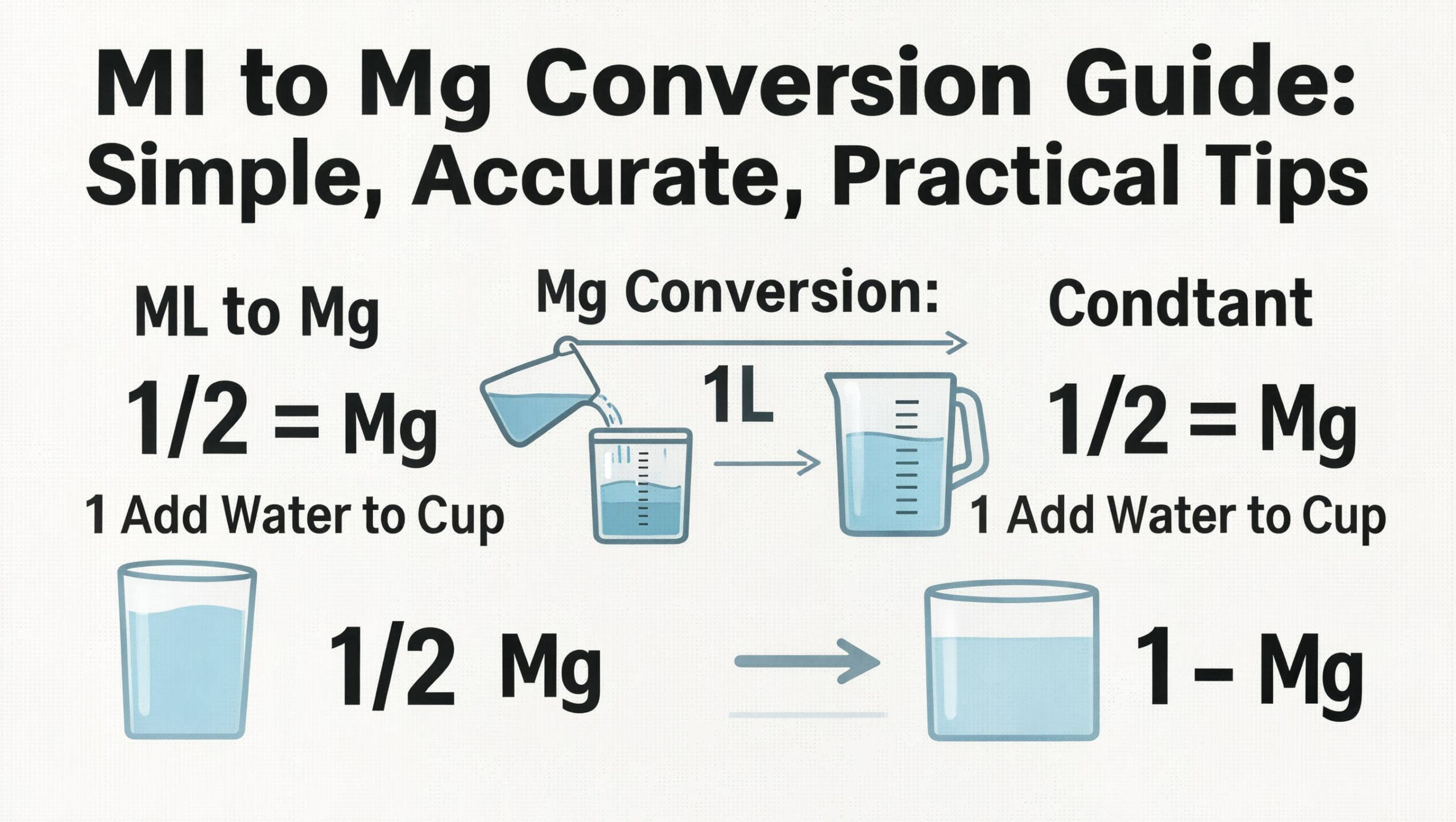
[Infographic: A simple conversion flow showing “volume in ml” plus “density in g/ml” leading to “grams,” then multiplied by 1,000 to reach “mg.”]
For example, if a liquid has a density of 1.2 g/ml and you have 10 ml, the calculation is 10 × 1.2 × 1000 = 12,000 mg. The liquid takes up 10 milliliters of space, but its mass is 12 grams, which equals 12,000 milligrams.
If the density is 0.8 g/ml, then 10 ml weighs 8,000 mg. Same volume, different mass. That is why the substance itself matters so much.
The Formula When Concentration Is Given
Sometimes you do not need density at all. If a product label gives concentration in mg/ml, the conversion is more direct:
mg = ml × concentration in mg/ml
This is common with liquid medications, supplements, flavoring solutions, lab solutions, and some chemical mixtures. The label might say 20 mg/ml, 50 mg/ml, or 100 mg per 5 ml. In those cases, you are not calculating the total mass of the liquid. You are calculating how many milligrams of the active ingredient are present in a measured volume.
For example, if a medicine label says 40 mg/ml and you take 2 ml, the active amount is 80 mg. The liquid itself weighs more than 80 mg, but the dose of the active ingredient is 80 mg.
This distinction is extremely important. A spoonful of medicine contains liquid, flavoring, stabilizers, and the active compound. The dose refers only to the active compound unless the label says otherwise.
ml to mg Conversion for Water
For water, the conversion is the easiest because water has a density close to 1 g/ml. In practical everyday use, 1 ml of water is usually treated as 1,000 mg.
That means:
- 0.5 ml of water is about 500 mg
- 1 ml of water is about 1,000 mg
- 2 ml of water is about 2,000 mg
- 5 ml of water is about 5,000 mg
- 10 ml of water is about 10,000 mg
- 100 ml of water is about 100,000 mg
This approximation is useful for cooking, basic science, cleaning mixtures, and everyday measuring. It is not a substitute for exact laboratory work where temperature, purity, and calibration may matter.
For ordinary household use, though, water provides the easiest mental model: milliliters become grams almost directly, and grams become milligrams by multiplying by 1,000.
Common Conversion Examples
Here are a few examples that show how different the answers can be depending on the substance.
Example 1: 1 ml of Water
Water is close to 1 g/ml.
Calculation: 1 × 1 × 1000 = 1,000 mg
So, 1 ml of water is approximately 1,000 mg.
Example 2: 5 ml of Water
This is a common teaspoon-sized measurement.
Calculation: 5 × 1 × 1000 = 5,000 mg
So, 5 ml of water is approximately 5,000 mg.
Example 3: 10 ml of Oil
Many cooking oils have densities around 0.9 g/ml, though the exact value depends on the type and temperature.
Calculation: 10 × 0.9 × 1000 = 9,000 mg
So, 10 ml of oil may weigh around 9,000 mg, not 10,000 mg.
Example 4: 2 ml of a 50 mg/ml Liquid
Here, you use concentration rather than density.
Calculation: 2 × 50 = 100 mg
So, 2 ml contains 100 mg of the active ingredient.
How to Convert Volume to Mass Step by Step
The safest way to handle an ml to mg conversion is to identify what kind of information you have. Are you trying to find the total mass of a liquid, or the amount of an active ingredient inside that liquid?
Start by checking the label, recipe, datasheet, or instructions. Look for density, usually written as g/ml, g/cm³, kg/L, or similar. If you see a concentration such as mg/ml, mg per 5 ml, or mg per teaspoon, use that instead.
Next, choose the right formula. Use density when you need the mass of the substance. Use concentration when you need the amount of a specific ingredient or compound.
Then calculate carefully. Keep units visible as you work, especially if the amount matters. A misplaced decimal can turn 0.5 ml into 5 ml, or 50 mg into 500 mg.
Finally, double-check the result against common sense. A few milliliters of water should equal a few thousand milligrams, not a few milligrams. A tiny dose of a concentrated liquid might contain only a few milligrams of an active ingredient, even though the liquid itself weighs much more.
Understanding Density in Plain English
Density is simply how “packed” a substance is. Imagine holding two identical measuring cups. One is filled with water, the other with syrup. The cups hold the same volume, but the syrup feels heavier because more mass is packed into the same space.
That is density at work. A dense liquid has more mass per milliliter. A less dense liquid has less mass per milliliter.
In real life, density can change with temperature. Warm liquids often expand slightly, which can make them less dense. For casual use, this difference is usually tiny. In laboratories and manufacturing, it can matter enough to require controlled conditions.
Density also depends on purity and composition. Saltwater is denser than fresh water. A sugar syrup is denser than plain water. A suspension may not be uniform unless shaken properly. These details explain why a label or official reference is better than a guess.
When You Should Use Concentration Instead
In health, supplements, medicine, and chemistry, concentration is often more useful than density. Concentration tells you how much of a particular substance is present in a certain volume of liquid.
For example, a children’s liquid medicine might say 160 mg per 5 ml. That does not mean the entire 5 ml weighs 160 mg. It means the active ingredient in that 5 ml dose is 160 mg.
This is why measuring liquid medicine with a kitchen spoon can be risky. Household spoons vary in size, and the concentration may be strong enough that a small error changes the dose meaningfully. An oral syringe, dosing cup, or marked dropper is much better.
If a label gives both volume and active amount, follow the label instructions exactly. For prescriptions, medical dosing, children’s medicine, pet medicine, or concentrated supplements, it is best to ask a qualified professional when anything is unclear.
Practical Uses in Everyday Life
The ml to mg relationship shows up more often than people expect. In the kitchen, it helps when comparing liquids by volume and powders by weight. In wellness products, it helps make sense of supplement labels. In skincare, it can help interpret ingredient concentrations. In science classes, it builds a foundation for understanding mass, volume, and density.
Cooking is a good example. Recipes often use teaspoons, tablespoons, cups, grams, and milliliters in the same set of instructions. Water-based liquids are easy to approximate, but oils, syrups, and pastes behave differently. That is why serious baking often favors a kitchen scale.
Supplements are another common example. A bottle might give a serving size in milliliters and an active amount in milligrams. To understand what you are taking, you need to read the serving size and concentration together.
In labs, this conversion is part of routine work. Researchers may prepare solutions, dilute samples, or calculate the mass of a liquid reagent. Small errors can affect results, so they rely on calibrated equipment, verified density values, and clear documentation.
Quick Reference Table for Water
Because water is the simplest case, this table can be useful for fast everyday estimates.
| Milliliters of Water | Approximate Milligrams |
|---|---|
| 0.1 ml | 100 mg |
| 0.25 ml | 250 mg |
| 0.5 ml | 500 mg |
| 1 ml | 1,000 mg |
| 2 ml | 2,000 mg |
| 5 ml | 5,000 mg |
| 10 ml | 10,000 mg |
| 15 ml | 15,000 mg |
| 30 ml | 30,000 mg |
| 100 ml | 100,000 mg |
This table should not be used for oils, syrups, alcohol, glycerin, medicines, or concentrated formulas unless their density or concentration matches the assumptions. For anything important, use the exact product information.
Common Mistakes to Avoid
One of the biggest mistakes is assuming that every liquid behaves like water. This shortcut is common, but it can be wrong enough to matter. Oils, syrups, alcohol solutions, and concentrated mixtures often need their own density values.
Another mistake is mixing up total liquid weight with active ingredient amount. A liquid supplement may weigh thousands of milligrams per serving, but contain only 25 mg of a vitamin or extract. The product label usually focuses on the active amount, not the total mass of the liquid.
People also run into trouble when they ignore “per serving” language. A label might say 100 mg per 2 ml, not 100 mg per 1 ml. Reading too quickly can double or halve the intended amount.
Decimal errors are another issue. The difference between 0.1 ml and 1 ml is tenfold. The difference between 0.05 ml and 0.5 ml is also tenfold. When dealing with small amounts, write the numbers clearly and avoid mental math if the result matters.
Measuring Tools That Improve Accuracy
The tool you use can be just as important as the formula. For liquids, a marked syringe or pipette is usually more accurate than a spoon. For powders, a scale that reads in grams or milligrams is more reliable than a scoop.
Kitchen measuring spoons are fine for many recipes, but they are not ideal for medication or precise supplements. Even a “teaspoon” can vary depending on the spoon shape and how carefully it is filled.
A digital kitchen scale is helpful for food and larger quantities. For very small masses, such as a few milligrams, a regular kitchen scale will not be sensitive enough. That level of precision requires a suitable milligram scale or professional equipment.
For lab work, use calibrated glassware, pipettes, balances, and documented density values. For medical dosing, use the device that comes with the product or one recommended by a pharmacist or clinician.
How Temperature and Formulation Affect Results
Temperature can slightly change density because liquids expand or contract. Water, oils, alcohols, and syrups can all behave differently as they warm or cool. In casual situations, this usually does not change the result enough to worry about.
In technical settings, however, temperature can become important. A lab may specify measurements at 20°C or another standard condition. That ensures the density value matches the actual measurement environment.
Formulation matters too. A suspension may contain particles that settle at the bottom of the bottle. If it is not shaken as directed, one dose may be weaker and another may be stronger. That is not a conversion problem; it is a mixing problem.
This is especially relevant for liquid medicines, nutritional products, and some chemical mixtures. When a label says “shake well,” it is there for a reason.
You may read this: Barron Trump Height Disease: Real Facts Vs Online Rumor.
Converting Labels That Say “mg per 5 ml”
Many liquid products use “mg per 5 ml” because 5 ml is a standard teaspoon-sized serving. To convert this into mg per ml, divide the milligrams by 5.
For example, 250 mg per 5 ml equals 50 mg per ml. If you take 2 ml, you get 100 mg. If you take 10 ml, you get 500 mg.
This approach is useful when the dose you need is different from the serving size on the label. Still, it should be used carefully. For medicine, do not change a dose unless the label or a qualified professional tells you to.
For supplements, the same math applies, but the same caution is wise. “Natural” does not automatically mean risk-free, and concentrated liquids can deliver a lot of an ingredient in a small amount.
In Medicine and Supplements
The most sensitive use of ml to mg is medical dosing. Liquid medications are often prescribed by volume because that is what a patient can measure, but the dose is based on milligrams of active drug.
For example, a prescription may say to take 5 ml twice daily, while the bottle shows the concentration. The prescriber and pharmacist use that concentration to make sure the patient gets the correct milligram dose.
This is why it is important not to swap products casually. Two bottles may look similar and have the same active ingredient, but one may be stronger. A dose of 5 ml from one bottle may not equal 5 ml from another bottle.
Children’s dosing deserves extra care because body weight, age, and concentration can all matter. Pet dosing is also sensitive because animals may need very different amounts than humans. When there is any doubt, ask a pharmacist, doctor, veterinarian, or other qualified professional.
Check this relevent to this post: Mg To Ml Conversion Guide: Simple Formula & Examples.
In Cooking and Baking
In cooking, exact conversions are usually less critical than in medicine, but they can still change the final result. Baking especially depends on ratios, hydration, and texture.
For water and milk-like liquids, volume measurements often work well enough. For oils and syrups, the weight may differ from water, which can matter in recipes that use grams. Honey, molasses, and glucose syrup are much heavier than water by volume, so measuring them as if they were water can throw off a formula.
Professional bakers often prefer weighing ingredients because weight is consistent. A cup of flour can vary depending on how it is scooped, but 100 grams is always 100 grams. The same idea applies to liquids when density matters.
If you are adapting a recipe from milliliters to milligrams, look up the density of the specific ingredient or use a scale when possible.
In Labs and Science Classes
In science, ml to mg calculations help students and professionals connect volume, mass, density, and concentration. These ideas appear in chemistry, biology, pharmacy, environmental testing, and food science.
A student might measure 3 ml of a liquid with a known density and calculate its mass. A technician might prepare a solution that contains a precise number of milligrams of solute per milliliter. A researcher might dilute a stock solution to reach a target concentration.
The math is not difficult, but the setup matters. You must know whether the problem is asking for total mass, solute mass, active ingredient amount, or concentration after dilution.
Once the terms are clear, the calculation becomes straightforward.
A Simple Way to Remember the Difference
Here is a helpful mental shortcut: milliliters tell you “how much space,” while milligrams tell you “how much stuff.” Density connects the two.
If you are measuring plain water, the shortcut is easy: 1 ml is about 1,000 mg. If you are measuring anything else, pause and check density or concentration.
Another easy reminder is this: density answers “how heavy is each milliliter?” Concentration answers “how much active ingredient is in each milliliter?”
That small distinction prevents most conversion errors.
FAQ
Is 1 ml always equal to 1000 mg?
No. It is only approximately true for water and liquids with a density close to water. Other substances can weigh more or less per milliliter, so you need density or concentration for an accurate answer.
How do I convert liquid medicine correctly?
Use the concentration on the label, usually shown as mg/ml or mg per 5 ml. Multiply the volume by the concentration. For prescription or children’s medicine, follow the label exactly and ask a pharmacist or clinician if anything is unclear.
What is the easiest formula to remember?
For total mass, use mg = ml × density × 1000 when density is in g/ml. For active ingredients, use mg = ml × mg/ml.
Why does oil convert differently than water?
Oil is generally less dense than water, so the same volume usually weighs less. For example, 10 ml of many oils may weigh around 9,000 mg rather than 10,000 mg, though the exact value depends on the oil.
Can I use a kitchen spoon for liquid medicine?
It is better to use an oral syringe, dosing cup, or marked dropper. Kitchen spoons can vary in size and may lead to dosing errors.
What if the label says mg per 5 ml?
Divide the milligrams by 5 to find the amount per milliliter. Then multiply by the number of milliliters you plan to measure.
Is a milligram smaller than a milliliter?
They measure different things, so one is not simply smaller than the other. A milligram measures mass, while a milliliter measures volume.
Do powders convert the same way as liquids?
Not exactly. Powders vary in bulk density depending on particle size, moisture, settling, and how they are scooped. For powders, weighing with a scale is usually better than converting from volume.
Conclusion
The most important thing to remember is that milliliters and milligrams do not measure the same property. One measures volume, the other measures mass. To move between them accurately, you need density for total mass or concentration for active ingredient amount.
For water, the shortcut is simple: 1 ml is about 1,000 mg. For anything else, the best answer depends on what you are measuring. A small label detail, such as g/ml or mg/ml, can completely change the calculation.
When the measurement affects health, safety, lab results, or a carefully balanced recipe, do not rely on guesswork. Check the label, use the right formula, measure with the right tool, and treat the numbers with the respect they deserve.