Sometimes a tiny measurement can create big confusion. You see “mg” on one label and “ml” on another, and suddenly a simple task feels like a math problem.
The truth is, mg to ml conversion is not always direct because milligrams measure weight, while milliliters measure volume. That means the correct answer depends on what substance you are measuring.
For water, the conversion is easy. But for oils, syrups, medicines, chemicals, or powders, density changes everything. That is why guessing can lead to wrong amounts, especially when medicine or concentrated liquids are involved.
This guide explains the conversion in plain English with formulas, examples, and safety notes, so you can understand it without feeling lost.
What Does mg Mean?
mg stands for milligram. It is a unit of mass or weight.
One milligram is very small. There are:
- 1,000 milligrams in 1 gram
- 1,000,000 milligrams in 1 kilogram
Milligrams are commonly used for:
- Medicine dosage
- Supplements
- Chemicals
- Nutrients
- Powdered ingredients
- Lab measurements
For example, a vitamin tablet may contain 500 mg of vitamin C. That tells you the amount of material by weight, not how much space it takes up.
What Does ml Mean?
ml stands for milliliter. It is a unit of volume.
One milliliter is equal to one-thousandth of a liter. It tells you how much space a liquid occupies.
Milliliters are commonly used for:
- Water
- Syrups
- Liquid medicine
- Cooking liquids
- Skincare liquids
- Cleaning solutions
- Laboratory fluids
For example, a medicine spoon may hold 5 ml of liquid. That tells you the liquid volume, not the weight of the active ingredient inside it.
Why mg to ml Is Not Always a Straight Conversion
The main reason mg to ml conversion can be confusing is that mass and volume are different things.
A milligram measures how heavy something is. A milliliter measures how much space something fills. These two values only connect when you know the substance’s density.
For example:
- 1 ml of water weighs about 1,000 mg
- 1 ml of cooking oil usually weighs less than 1,000 mg
- 1 ml of honey weighs more than 1,000 mg
So, the same volume can have different weights depending on the liquid.
The Basic Formula for mg to ml
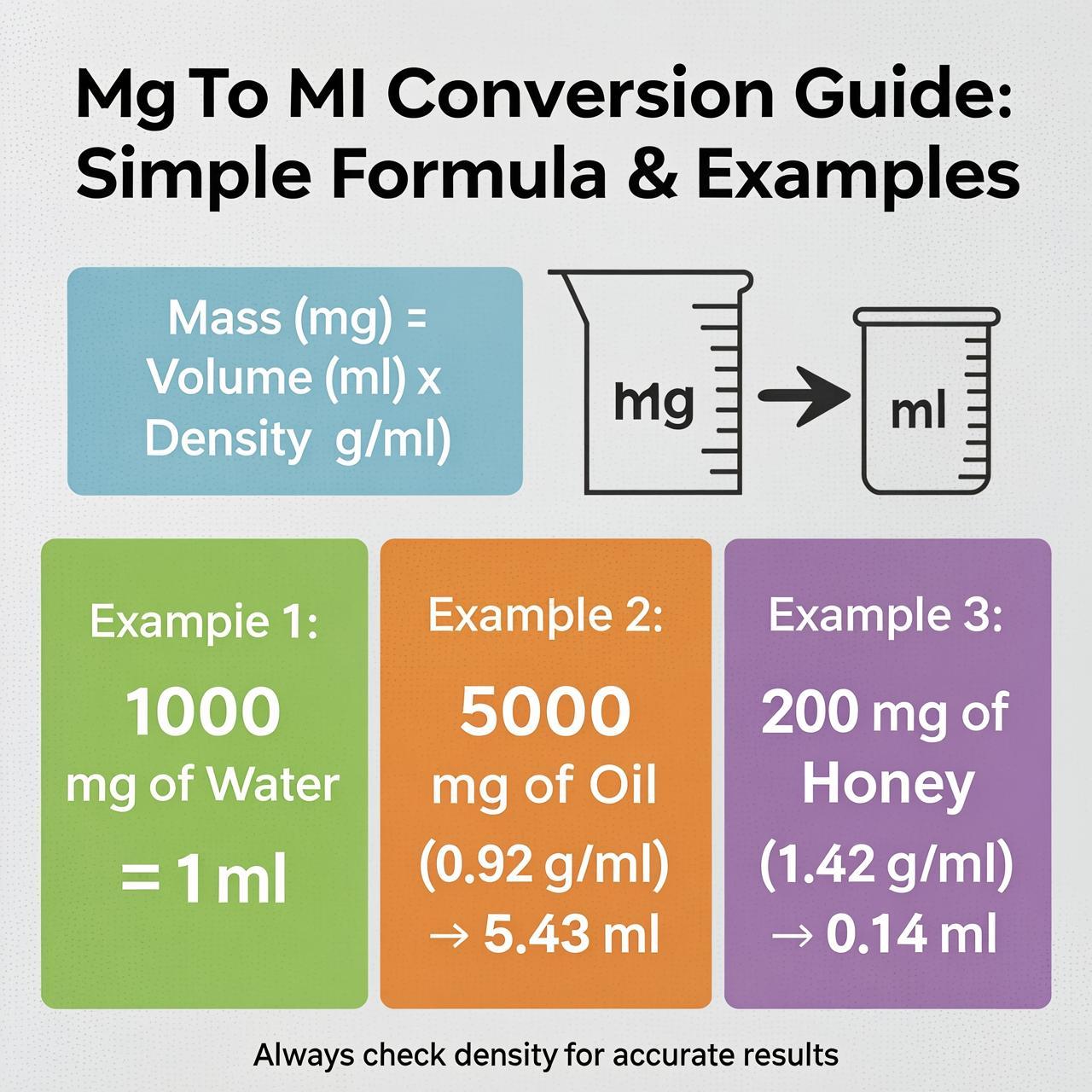
To convert mg to ml, use this formula:
ml = mg ÷ density ÷ 1000
Where:
- mg = milligrams
- density = grams per milliliter
- ml = milliliters
For water, the density is about 1 g/ml. So the formula becomes very simple:
ml = mg ÷ 1000
That means:
- 100 mg of water = 0.1 ml
- 500 mg of water = 0.5 ml
- 1,000 mg of water = 1 ml
- 5,000 mg of water = 5 ml
Easy Water Conversion Table
For water or water-like liquids, you can use this simple table:
| Milligrams | Milliliters |
|---|---|
| 100 mg | 0.1 ml |
| 250 mg | 0.25 ml |
| 500 mg | 0.5 ml |
| 1,000 mg | 1 ml |
| 2,500 mg | 2.5 ml |
| 5,000 mg | 5 ml |
| 10,000 mg | 10 ml |
| 15,000 mg | 15 ml |
This table works best for water because water has a density close to 1 g/ml.
mg to ml for Medicine
Medicine conversion needs extra care. Many liquid medicines are not measured by only converting weight to volume.
Instead, medicine labels usually show concentration, such as:
- 250 mg / 5 ml
- 500 mg / 10 ml
- 125 mg / 5 ml
This means the medicine has a certain amount of active ingredient inside a certain liquid volume.
For example, if a medicine says 250 mg per 5 ml, then each 5 ml dose contains 250 mg of medicine.
Medicine Formula
Use this formula:
Required ml = dose needed ÷ available mg × available ml
Example:
A label says 250 mg / 5 ml. You need 500 mg.
500 ÷ 250 × 5 = 10 ml
So, the required amount is 10 ml.
Never guess liquid medicine amounts. Use the label, dosing cup, syringe, or pharmacist instructions.
Common Medicine Examples
| Label Strength | Needed Dose | Liquid Needed |
|---|---|---|
| 250 mg / 5 ml | 250 mg | 5 ml |
| 250 mg / 5 ml | 500 mg | 10 ml |
| 125 mg / 5 ml | 250 mg | 10 ml |
| 500 mg / 10 ml | 250 mg | 5 ml |
These examples show why concentration matters more than a simple conversion.
Converting Liquids by Density
When the liquid is not water, density must be included. Density tells you how much a substance weighs in a specific volume.
Approximate examples:
| Substance | Approx. Density |
|---|---|
| Water | 1.00 g/ml |
| Olive oil | 0.91 g/ml |
| Milk | 1.03 g/ml |
| Honey | 1.40 g/ml |
| Glycerin | 1.26 g/ml |
Because honey is denser than water, 1 ml of honey weighs more than 1 ml of water. Oil is lighter than water, so 1 ml of oil weighs less.
Example: Oil Conversion
Let’s convert 910 mg of olive oil into ml.
Approximate density of olive oil = 0.91 g/ml
Formula:
ml = mg ÷ density ÷ 1000
910 ÷ 0.91 ÷ 1000 = 1 ml
So, 910 mg of olive oil is about 1 ml.
Example: Honey Conversion
Let’s convert 1,400 mg of honey into ml.
Approximate density of honey = 1.40 g/ml
1,400 ÷ 1.40 ÷ 1000 = 1 ml
So, 1,400 mg of honey is about 1 ml.
This is why density is important. If you treated honey like water, your answer would be wrong.
Why Online Calculators Can Be Wrong
Many online converters assume the substance is water. That is fine for water-based liquids, but not for everything.
A calculator may say 1,000 mg equals 1 ml. That is only accurate when the density is 1 g/ml.
It may not be accurate for:
- Oils
- Syrups
- Creams
- Gels
- Powders
- Concentrated medicine
- Chemical solutions
For accurate results, always check whether the calculator asks for density or concentration.
mg to ml in Cooking and Recipes
Cooking conversions are often more forgiving than medical conversions, but accuracy still matters.
Water-like ingredients are easy:
- 1,000 mg water = 1 ml
- 5,000 mg water = 5 ml
But thick or dense ingredients need caution:
- Honey
- Molasses
- Syrup
- Nut butter
- Oils
- Creams
For recipes, a kitchen scale is usually better for dry ingredients. Measuring spoons are better for liquids. You can also read about Barron Trump Height Disease: Real Facts Vs Online Rumor.
Common Mistakes to Avoid
Many people make conversion errors because they treat all substances like water.
Avoid these mistakes:
- Assuming every 1,000 mg equals 1 ml
- Ignoring density
- Confusing mg with ml on medicine labels
- Using kitchen spoons for medical dosing
- Measuring powders by volume without checking weight
- Relying on random online calculators without substance details
The safest method is to know what you are measuring first.
Simple Rule for Beginners
Here is the easiest way to think about it:
If the substance is water, mg to ml is simple: divide by 1,000.
If the substance is not water, you need density or concentration.
For medicine, always use the strength written on the label.
When You Should Not Convert Yourself
Do not rely on manual conversion when the measurement affects safety.
Be extra careful with:
- Prescription medicine
- Children’s medicine
- Pet medicine
- Lab chemicals
- Essential oils
- Concentrated supplements
- Injectable liquids
In these cases, ask a pharmacist, doctor, veterinarian, or qualified professional.
Quick Conversion Reference
For water-based liquids:
| mg | ml |
|---|---|
| 50 mg | 0.05 ml |
| 100 mg | 0.1 ml |
| 200 mg | 0.2 ml |
| 500 mg | 0.5 ml |
| 1,000 mg | 1 ml |
| 2,000 mg | 2 ml |
| 5,000 mg | 5 ml |
| 10,000 mg | 10 ml |
This is useful for simple learning, but it should not replace label-based dosing for medicine.
FAQ
Is 1 mg equal to 1 ml?
No. One mg is a unit of weight, while one ml is a unit of volume. For water, 1 ml is about 1,000 mg.
How do I convert mg to ml?
Use the formula: ml = mg ÷ density ÷ 1000. For water, simply divide mg by 1,000.
How many ml is 500 mg?
For water, 500 mg equals 0.5 ml. For other liquids, the answer depends on density.
How many ml is 1000 mg?
For water, 1,000 mg equals 1 ml. For oil, honey, syrup, or medicine, you need density or concentration.
Is medicine converted the same way?
Not always. Liquid medicine depends on concentration, such as 250 mg per 5 ml. Always follow the label or medical advice.
Why does density matter?
Density tells you how much weight fits into a certain volume. Different liquids have different densities, so their conversions are different.
Can I use a kitchen spoon for medicine?
No. Kitchen spoons are not accurate for medicine. Use a dosing syringe, medicine cup, or pharmacist-approved measuring tool.
What is the easiest conversion for water?
For water, divide milligrams by 1,000. So 2,000 mg of water equals 2 ml.
Check details regarding Ammonia Smell, Odor, Risks & Safety Guide.
Conclusion
Understanding mg to ml becomes much easier once you know the difference between weight and volume. Milligrams measure mass, while milliliters measure liquid space.
For water, the conversion is simple: divide by 1,000. For other liquids, density changes the answer. For medicine, concentration on the label matters most.
When accuracy matters, especially with health, children, pets, or chemicals, never guess. Use the correct formula, read the label carefully, and ask a professional when needed.